COMPARISON · OPERATION IN PRACTICE
Gimbal, fluid head or FlexShooter for heavy telephoto lenses?
Which movement suits my photography?
With heavy telephoto lenses I want to support the weight and still stay on the subject. Different systems lead to the goal in different ways. Here I bring together the experiences from my existing reports: What do I like about the FlexShooter, what are the strengths of the gimbal and when is a monopod a different type of solution?
My specific use
FlexShooter Pro II for around three months with Nikon Z9 and Z8, mainly 400 mm f/2.8 and 600 mm f/4, including flying birds of prey in different hides.
My other reports
SUNWAYFOTO GH-04, Ridley with AirHed Cine CC and Leofoto MPG-01 with MPC-366C show other operating concepts.
Crucial question
What movement do I need frequently, how much space do I have available and how should all the equipment be carried and managed?
Type of comparison
A comparison of working methods based on my reports. The systems were not measured against each other under identical conditions.
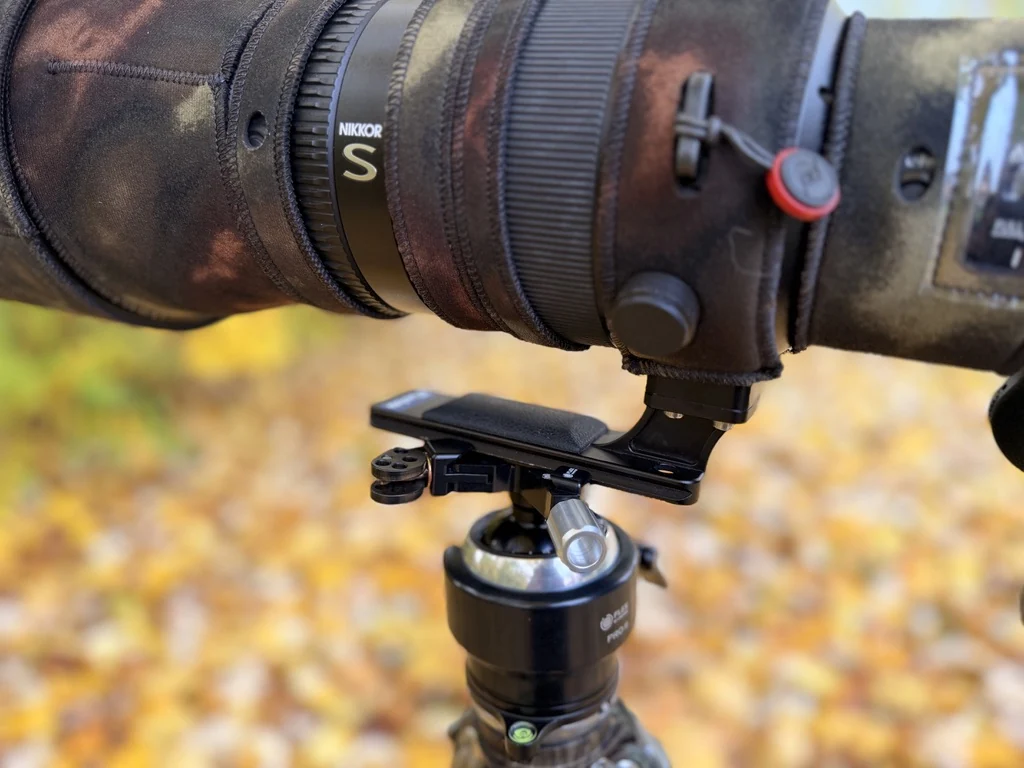
FlexShooter: my specific highlight when tracking
I have been using the FlexShooter Pro II for around three months. With Nikon Z9 and Z8 and predominantly 400 mm f/2.8 and 600 mm f/4, I particularly enjoyed tracking flying birds of prey in different hides. Once the vertical alignment is set, I can use the silver wheel to enable lateral movement and follow it with the camera.
This way of operating suits me very well. However, it does not follow that the same head is the best choice for every movement and every photographer. My positive impression relates to my equipment and this way of working.
To the complete FlexShooter Pro II test
Gimbal: first balance, then guide
In the report on the SUNWAYFOTO TL3230CM with GH-04, the focus is on the interaction between the stable base and the movable telephoto lens. The gimbal allows the supported combination to be guided horizontally and vertically. What is important is the right balance of the complete equipment.
If you try out a gimbal, you should only assess the feeling of movement after setting it up. Simply comparing a high manufacturer load capacity does not explain how your own lens can be used.
To the SUNWAYFOTO-TL3230CM-and-GH-04 test
Fluid head: my Ridley system and its limits
I like the controlled movement of the Ridley with AirHed Cine CC. The tripod's leveling base also helps with horizontal alignment. These two functions fulfill different tasks: the base aligns, the head guides the camera.
This positive impression also includes the limitation from my Ridley report: With the heavy 600 mm lens, slight movements can still be noticeable in the event of wind or small touches. This affects the entire structure. It is not proof that every fluid head or tripod behaves the same.
To the Ridley test with AirHed Cine CC
Monopod: relief with a different distribution of tasks
With the Leofoto MPG-01 on the MPC-366C, the practical difference is the vertical tilt. The head handles the up and down change, while lateral movements are created by rotating the monopod. Compared to my previous tilting of the entire monopod, this is exactly the gain described.
The monopod and mounted equipment must still be held securely. It is therefore a different solution than a free-standing tripod and not a direct replacement for every shooting situation.
To the Leofoto MPG 01 and MPC 366C test
The differences at a glance
| System from my reports | Service is the focus | Check before choosing |
|---|---|---|
| FlexShooter Pro II | My highlight: lateral tightening after the vertical alignment has been set | Operating feel with the complete camera and lens combination |
| GH-04 on TL3230CM | Balanced telephoto lens can be guided horizontally and vertically | Balance, range of motion and overall weight |
| AirHed Cine CC on Ridley | controlled movement; separate leveling base on the tripod | Silence of the entire structure with the longest focal length |
| MPG-01 to MPC-366C | Vertically over the head, horizontally over the monopod | Permanently safe holding and guiding of equipment |
What counts for my own decision
For me, the lateral tightening is the crucial point with the FlexShooter. I used the head in different hides with Nikon Z9 and Z8, mostly with my 400mm f/2.8 or 600mm f/4. Photographing flying birds of prey worked very well with it. That's why this operation is a concrete reason for me to enjoy working with my head.
When it comes to the tripod itself, I think differently today than I did before: for a long time I mainly bought the most expensive models, such as those from Gitzo. I am now so impressed by the products I use from 3 Legged Thing, SUNWAYFOTO and Leofoto that I will probably no longer use my heavy Gitzo. It offers me no advantage for the way I work today that outweighs the weight for me.
And if two tele setups are to be available?
The SUNWAYFOTO GH-03II answers another question: It offers space for two camera-lens combinations mounted at the same time on a tripod base. That's what excites me about this structure. The weight, width and setup of both sides must be suitable for the task.
MY VERDICT
The right movement decides
For me, the FlexShooter worked very well for lateral tracking. My other reports show that gimbals, fluid headers and monopods can also be useful solutions with different strengths. Everyone has to decide for themselves which operation suits their own photography. Fortunately, the choice of supports for heavy telephoto lenses is now wide.